Most people judge their water by the obvious stuff. Does it look clear? Does it smell okay? Does the coffee taste normal? Fair enough. Those things matter. But home water quality goes a little deeper than what you notice in one quick glass from the tap.
Water moves through the whole house. It touches your dishes, laundry, plumbing, water heater, bathroom fixtures, skin, hair, and every appliance that depends on it. So when the water has minerals, sediment, chlorine taste, or other unwanted elements, the effects can show up in all sorts of small ways.
Maybe the shower glass gets cloudy too fast. Maybe your towels feel rough even after washing. Maybe the kettle has white scale at the bottom. None of it feels like a crisis, but over time, it gets annoying. And sometimes expensive.
Also worth reading
Why Water Quality Feels Personal
Every home has its own water story. City water may be treated and tested, but it can still carry chlorine taste, minerals, or sediment by the time it reaches your faucet. Well water can be even more unpredictable, depending on local soil, pipes, nearby land use, and natural mineral levels.
That’s why one family might be mostly concerned about drinking water, while another is fighting hard water buildup in every bathroom. Someone else may just want laundry that feels softer or fixtures that don’t need scrubbing every few days.
There isn’t one perfect system for every house. The right answer starts with understanding the problem first.
When Whole-House Protection Makes Sense
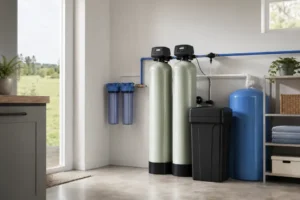
For homeowners who notice issues across multiple rooms, whole-home filtration can be a smart place to start. Instead of treating water only at one tap, this type of system works as water enters the home, helping improve what flows to showers, sinks, laundry machines, and appliances.
That can be especially helpful when the concern is chlorine taste, odor, sediment, or general water clarity. It may also help reduce the wear and tear that untreated water can place on plumbing fixtures and household equipment.
It’s not about making the system bigger than it needs to be. It’s about treating the water where the issue begins, before it spreads through the home.
Drinking Water Deserves Special Attention
Some people are mainly worried about the water they drink and cook with. That’s completely reasonable. A glass of water should taste clean. Ice should not smell strange. Coffee and tea should taste like coffee and tea, not like whatever is coming through the pipes.
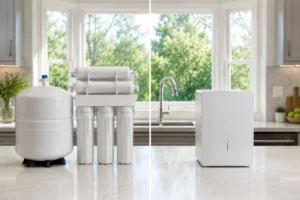
This is where reverse osmosis systems are often considered. These systems are commonly installed under the kitchen sink and are designed to provide highly filtered water for drinking and cooking. They can help reduce many dissolved substances that basic filters may not fully address.
For households that buy bottled water every week, a dedicated drinking-water system can also be more convenient. No more hauling heavy cases from the store or stacking plastic bottles in the pantry.
Hard Water Has a Way of Taking Over
Hard water is one of those problems that sneaks into daily life. You may not notice it right away, but then suddenly the signs are everywhere. White buildup around faucets. Soap that doesn’t lather well. Dry-feeling skin after showers. Spots on dishes. Laundry that never feels quite soft.
Over time, hard water can also affect water heaters, dishwashers, washing machines, and plumbing. Those hardness minerals can build up inside equipment and make things work harder than they should.
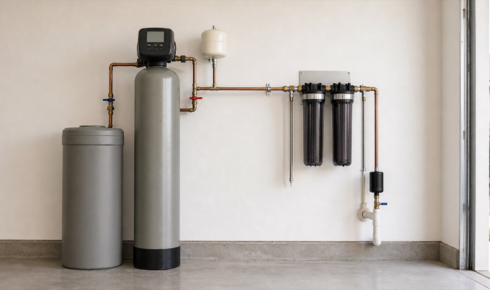
That’s where water softeners come in. A softener helps reduce hardness minerals, making water easier on fixtures, appliances, laundry, and skin. It is not the same as a filter, though. That part matters. Softening and filtration solve different problems, and many homes benefit from using both together.
One System May Not Do Everything
A common mistake is thinking one water product will fix every possible issue. It usually doesn’t work that neatly. A carbon filter may improve taste and odor, but it won’t fully solve hardness. A softener handles mineral buildup, but it may not remove certain contaminants. A drinking-water system can improve water at one faucet, but it won’t treat showers or laundry.
Good water treatment is more like building a small plan than buying a random gadget. First, test the water. Then look at where the problem shows up. Finally, choose the right system or combination of systems.
It sounds simple, and honestly, it should be. But skipping that first step often leads to disappointment.
The Everyday Benefits Are Easy to Miss
Better water does not always announce itself loudly. It’s often quieter than that.
The shower feels better. Glassware looks cleaner. Soap rinses off more easily. The dishwasher doesn’t leave as many spots. The coffee tastes smoother. Fixtures stay cleaner longer. Laundry feels a little nicer. These are ordinary things, sure, but ordinary things are most of what home life is made of.
And when appliances are protected from buildup and sediment, there may be longer-term savings too. Not always instant, not always dramatic, but practical.
Maintenance Matters More Than People Think
Even the best system needs proper care. Filters have to be changed. Softener salt needs to be checked. Drinking-water systems may need membrane replacement from time to time. If maintenance is ignored, performance drops slowly, and people may not notice until the water starts feeling off again.
The good news is that maintenance does not have to be complicated. A well-installed system should come with clear service expectations. Homeowners should know what needs to be done, when it needs to happen, and who to call when something seems wrong.
Water treatment should make life easier, not turn into a second job.
Final Thoughts
Clean, comfortable water is one of those home upgrades that quietly improves daily life. You may not think about it every morning, but you notice when it’s missing. Bad taste, scale, spots, dry skin, cloudy ice, rough laundry — these little frustrations have a way of wearing people down.
The right water solution depends on what’s actually in your water and how your household uses it. For some homes, filtration is enough. For others, softening is the missing piece. And for many families, a thoughtful combination gives the best result.
Good water should feel simple. Turn on the tap, fill the glass, take a shower, run the laundry, and trust what’s flowing through your home.